
From Chatbots to Agents
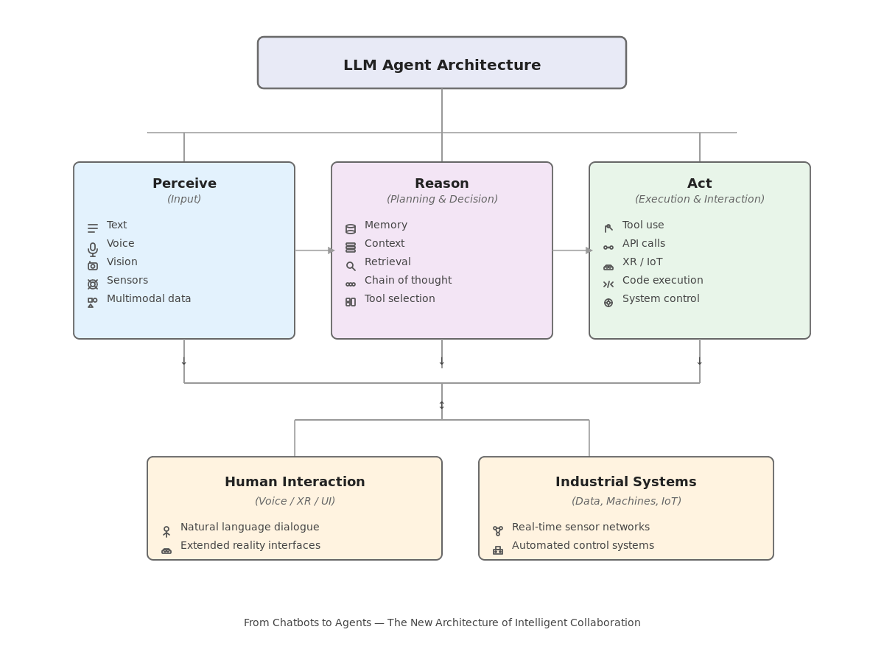
Artificial Intelligence (AI) is entering its most transformative phase — the era of agents [1]. Large Language Models (LLMs) are evolving from passive chatbots into goal-driven, reasoning systems that can plan actions, use tools, and interact across modalities. OpenAI’s GPT-models, Anthropic’s Claude, and Meta’s AI-enabled glasses all reflect this shift toward Agentic systems that perceive, reason, and act.
In industrial environments, this evolution is not a luxury; it’s essential. Manufacturing, energy, and aerospace sectors face global skills shortages and complex data silos. Workers often lack immediate access to expert knowledge when diagnosing equipment faults or applying safety procedures. Traditional automation can process data but cannot explain or contextualize it. LLM-based agents can.
Why Industry Needs Agentic AI
LLM agents combine natural-language understanding, contextual memory, and tool orchestration to act as intelligent intermediaries between humans, data, and machines. An operator can ask, “What caused the pressure anomaly on Pump A-7?” and receive a response that merges sensor readings, maintenance history, and procedure steps cited from the right document. A technician wearing AR glasses can request, “Show me the torque pattern for this valve,” and see the instruction projected directly on the digital twin. Such examples illustrate a practical shift from static manuals and dashboards to interactive, conversational, and situational intelligence. The result is faster decision-making, safer operations, and continuous learning on the job.
XR5.0’s Solution for Agentic AI
The EU-funded XR5.0 project brings this transformation to industry by merging Extended Reality (XR) with LLM-powered agents. Aligned with the Industry 5.0 vision, XR5.0 focuses on human-centric, explainable, and sustainable AI enhancing human expertise instead of replacing it. Within XR5.0, Innov-Acts has developed the LLM Chat Engine, a scalable platform that delivers industrial-grade agents through secure APIs and XR interfaces. The system transforms large technical documents, manuals, and IoT data into an accessible conversational layer that workers can interact with via text or speech.
Inside the XR5.0 LLM Chat Engine
The Chat Engine implements a Retrieval-Augmented Generation (RAG) architecture enhanced with multi-agent orchestration [2]. Documents are parsed and semantically chunked before embedding, preserving technical structure and improving recall accuracy. Benchmarking demonstrated 99.07 % faithfulness and 93.37 % recall, achieving near-zero hallucinations — crucial for safety-critical domains [3].
The backend runs on FastAPI, integrates easily with enterprise systems, and supports cloud, edge, or on-premise deployments. Data residency and security are built-in: all indexing and retrieval can stay within the company’s infrastructure, meeting GDPR and AI Act requirements.
LLM Agents Meet Extended Reality
Connecting the Chat Engine with XR devices makes knowledge access hands-free and immersive. Speech-to-Text (STT) and Text-to-Speech (TTS) components enable natural dialogue through headsets or AR glasses. A worker can talk to the agent, receive spoken guidance, and view annotated instructions within the physical workspace. This integration transforms XR from a visualization tool into an interactive expert assistant that understands context and supports real-time operations.
Design Principles
XR5.0’s approach to LLM agents follows four guiding principles:
- Human-in-the-Loop: Operators remain in control, validating and refining AI suggestions.
- Transparency: Each answer can be traced to its source; XR5.0’s XAI methods can be integrated as LLM tools.
- Compliance and Security: Local data handling ensures conformity with EU AI Act and GDPR.
- Openness: REST, MQTT, and WebSocket APIs make integration simple; XR5.0 effectively offers LLM Agents-as-a-Service for industry.
Agentic AI in XR5.0 is designed to augment, not automate away human expertise.Technicians and engineers collaborate with digital co-workers that provide explanations, recall past actions, and learn from feedback. This partnership model strengthens trust and accelerates upskilling. In addition, XR5.0’s LLM Chat Engine embodies open interfaces, transparent reasoning, and respect for data ownership. Thereby, XR5.0 ensures that AI innovation remains both competitive and responsible.
Conclusion
LLM agents are redefining how humans interact with machines and knowledge. Within XR5.0, these agents are operational tools that make industrial expertise accessible through natural conversation and immersive visualization.
The XR5.0 LLM Chat Engine demonstrates that Agentic AI can be explainable, secure, and immediately useful in real-world factories and infrastructures. It represents a practical step toward Industry 5.0 where technology empowers people, strengthens resilience, and keeps intelligence close to where work happens.
Learn more at https://xr50.eu or contact info@innov-acts.com for access to the XR5.0 LLM Chat Engine.
References
[1] McKinsey & Company (2025) Seizing the agentic AI advantage. Available at: https://www.mckinsey.com/capabilities/quantumblack/our-insights/seizing-the-agentic-ai-advantage (Accessed: 15 October 2025).
[2] Lewis, P., Perez, E., Piktus, A., Petroni, F., Karpukhin, V., Goyal, N., Küttler, H., Lewis, M., Yih, W.T., Rocktäschel, T. and Riedel, S., 2020. Retrieval-augmented generation for knowledge-intensive nlp tasks. Advances in neural information processing systems, 33, pp.9459-9474.
[3] Tomkou, D., Fatouros, G., Andreou, A., Makridis, G., Liarokapis, F., Dardanis, D., Kiourtis, A., Soldatos, J. and Kyriazis, D., 2025. Bridging industrial expertise and xr with llm-powered conversational agents. arXiv preprint arXiv:2504.05527.