Since 2021, the European Commission (EC) has highlighted the need to build on top of the digital focus introduced in Industry 4.0 standards, with the intention to generate a globally competitive and world-leading industry which speeds up investments in research and innovation, but is also sustainable and resource-efficient. This new strategy, known as Industry 5.0 (I5.0), introduced new initiatives concentrated on the adoption of human-centric approaches for digital technologies, including Artificial Intelligence (AI) and Extended Reality (XR) solutions and the up-skilling / re-skilling of European workers’ digital skills.
Although the adoption of AI and XR solutions is progressing in an accelerated pace in multiple industrial scenarios, many challenges arise. The high level of complexity encountered in AI models remains a drawback for widespread industrial adoption. AI models are defined by large numbers of interconnected parameters which tend to decrease the understanding of a model’s decision-making processes from a human perspective, thus generating an issue of trust. Furthermore, state-of-the-art XR applications are built based on an “one-size-fits-all” philosophy that does not consider the characteristics of individual workers. Hence, they fall short when it comes to supporting the emerging wave of Industry 5.0 (I5.0) applications that are destined to be human-centric and emphasise trustworthy human-machine collaboration.
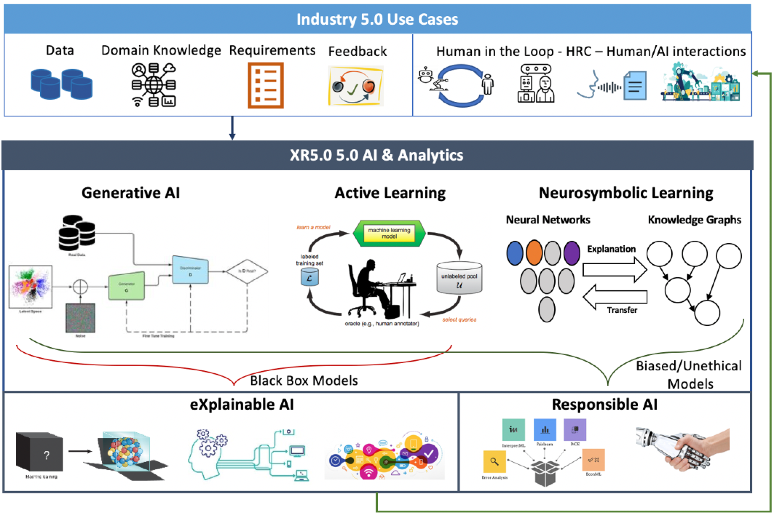
The XR5.0 project demonstrates and validates novel Human-Centric concepts and AI-based XR paradigms tailored to the requirements of I5.0 applications. It combines a unique blend of XR technologies and advanced AI paradigms, including AI technologies that foster human-machine cooperation such as eXplainable Artificial Intelligence (XAI), NeuroSymbolic Artificial Intelligence (NSAI), Active Learning (AL) and Generative AI (GenAI). The research, development and combination of these paradigms, empower novel XR environments that visualise recommendations, classifications, and explanations to provide human experts with access to enriched, detailed, and more accurate information.
eXplainable Artificial Intelligence (XAI)
The XAI components developed for the purposes of the XR5.0 project are designed to provide useful insights and clarity into complex AI models that can be seen as “black-boxes”. To serve a variety I5.0 applications and assist human experts in cases such as Rapid Human Centric AI-Enabled Product Design and Human Centered Remote Maintenance and Asset Management, the XR5.0 project provides solutions for three distinct types of XAI models:
- Glass-Box Models: Designed for inherently interpretable outputs through human-centric, concept-driven models that embed interpretability directly into the AI process.
- Post-Hoc Methods: Advanced tools that provide explanations for black-box models, allowing integration into existing workflows without retraining.
- Human-Centric GPT-Based Interaction: A conversational interface leveraging large language models (LLMs) for intuitive and interactive AI explanations.
NeuroSymbolic Artificial Intelligence (NSAI)
For the purposes of the XR5.0 project, the NeuroSymbolic AI (NSAI) components introduce a symbolic reasoning level to traditional AI models allowing domain experts to generate and/or extract semantic rules and reasoning out of “black-box” models. To further elaborate, the NSAI solution consists of 2 modules; a Neural Network (NN) that is responsible for tasks like object detection / image recognition and a symbolic reasoning part that is responsible for generating rules that will guide the training of the NN. Such rules are derived from human interaction, thus placing the human experts at the core of the AI modeling and training. The XR5.0 project utilizes NSAI in multiple I5.0 scenarios such as Anomaly detection of complex Water Pipe Networks based on XR streaming environments and Increased Effectiveness and Safety of Product Assembly and Repair Processes.
Active Learning (AL)
The rapid advancements in the field of Artificial Intelligence (AI) and Machine Learning (ML) have imposed the necessity for development of new ways of human-machine interactions. The XR5.0 has created a novel paradigm that enhances human – AI collaboration by combining immersive environments (XR applications) with Active Learning (AL) approaches, such as human-in-the-loop. The AL component empowers domain experts to be in the forefront when using AI as it allows them to directly interact with the AI models (e.x. NSAI models) in immersive environments, thus enhancing algorithmic accuracy, expert knowledge and human cognition. This approach is utilized in I5.0 scenarios such as Rapid Human Centric AI-Enabled Product Design, Anomaly detection of complex Water Pipe Networks based on XR streaming environments, Object Detection in XR streaming environments and Increased Effectiveness and Safety of Product Assembly and Repair Processes.
Generative Artificial Intelligence (GenAI)
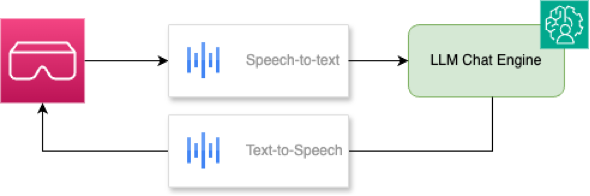
The landscape of artificial intelligence has been transformed by Large Language Models (LLMs) and Generative AI (GenAI), fundamentally changing human-computer interaction through natural language interfaces. The XR5.0 project integrates GenAI technologies with XR environments to enhance human-AI collaboration, aligning with Industry 5.0 principles. The GenAI paradigm introduces a novel approach to industrial training and applications by combining AI-powered conversational capabilities with immersive XR experiences, aligned with Industry 5.0’s human-centric vision. The GenAI component incorporates an LLM Chat Engine that delivers intelligent, context-sensitive guidance and a vector database for integrating proprietary or domain specific knowledge. The XR5.0 project employs the GenAI component in I5.0 scenarios such as Rapid Human Centric AI-Enabled Product Design, Human Centred Remote Maintenance and Asset Management, Operator 5.0 Training for Smart Water Pipes based on XR Streaming, Worker Centric Aircraft Maintenance Training and Human Centric Guidance and Troubleshooting for Customer Service.