Artificial Intelligence (AI) is increasingly shaping the way industrial operations are managed, optimized, and monitored. From anomaly detection in pipelines to predictive maintenance in factories, AI offers speed, precision, and foresight that would be impossible for humans alone. Yet one critical barrier remains: trust. Operators often struggle to understand how AI systems reach their conclusions, especially when decisions impact safety, efficiency, and costs.
This is where the work of XR5.0’s Work comes into play. Focus on integrating Explainable AI (XAI) into Extended Reality (XR) environments, creating solutions that not only visualize outcomes of AI models but also empower human operators to interpret, validate, and act upon them in real time.
From Black Box to Transparent Insights
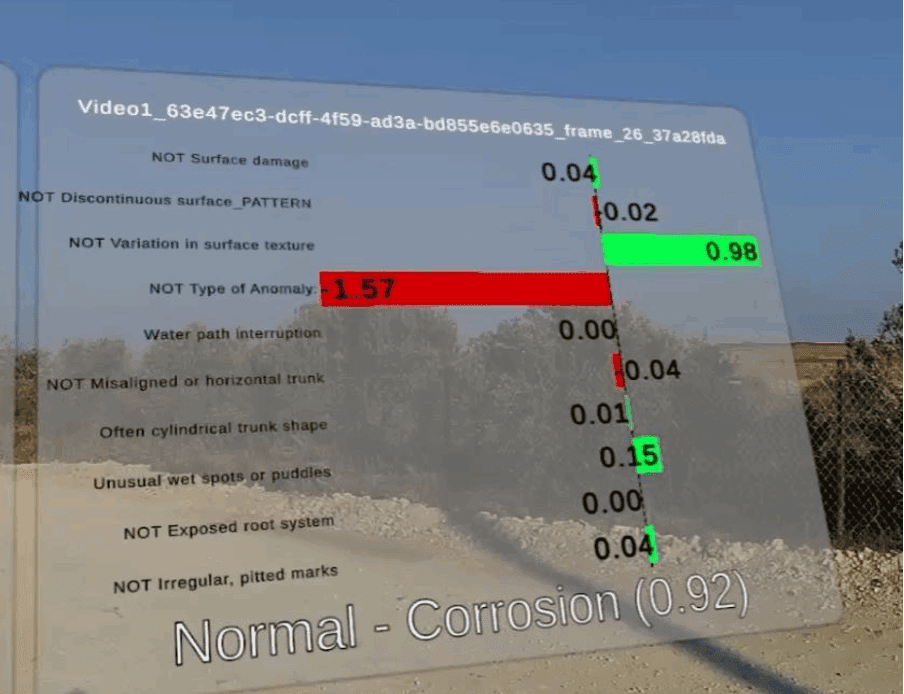
Traditional AI often functions as a “black box,” producing outputs without offering clear reasoning. For industrial operators, this can be a serious challenge. If an AI model flags an anomaly in a pipeline, simply knowing that “something is wrong” is not enough. Operators need to know why the anomaly has been detected, what data contributed to that decision, and how confident the system is.
Through immersive AR and VR applications, XR5.0 is making this process more transparent. Anomalies and recommendations generated by AI are no longer just numbers on a dashboard, they are placed directly into the operator’s field of view, linked to digital twins of equipment, and enhanced with explanations that highlight causes, contributing sensor data, and suggested next steps.
Building Human-Centric Interfaces
A key part of this work is the design of lightweight, modular user interfaces tailored for XR. Operators need fast, intuitive access to AI explanations without being overwhelmed by information. Popups, contextual menus, and interactive markers allow workers to call up details only when needed, reducing cognitive overload.
Equally important is the integration of AI-powered assistants within XR environments. Instead of searching through complex datasets, operators can simply ask the system, in natural language, questions such as: “What aquipment is essential for cleanning the pipeline?” or “What maintenance action is recommended?” The assistant can then provide explanations drawn from the AI models, displayed in both text/voice and visual overlays.
Handling Real-World Complexity
Integrating AI explanations into XR is not without challenges. Industrial environments are complex, and XR devices vary widely in terms of performance, sensors, and tracking capabilities. To address these issues, the XR5.0 team has focused on several strategies:
Device adaptability: Ensuring that explanations remain correctly aligned and stable, even when device tracking accuracy differs.
Information filtering: Designing adaptive visualization strategies that present only the most relevant details, preventing cognitive overload in information-rich scenarios.
Performance optimization: Developing rendering pipelines that allow mobile-class XR devices to display complex recommendation-rich environments without sacrificing responsiveness.
By addressing these challenges, the framework ensures robustness across different XR platforms and readiness for deployment in real-world industrial contexts.
Human-in-the-Loop Intelligence
One of the most powerful aspects of this approach is its emphasis on human-in-the-loop methods. AI is not designed to replace operators, but to work alongside them. Immersive technologies provide operators with the context and clarity they need to evaluate AI outputs, challenge or validate recommendations, and ultimately make informed decisions.
This collaboration improves both sides of the equation: AI models become more accurate through human feedback, and operators enhance their decision-making with the support of transparent and explainable insights.
Towards Smarter and Safer Industry
The integration of explainable AI into XR is more than a technical innovation, it is a step toward reshaping industrial workflows. By allowing operators to see, understand, and interact with AI-driven insights in the context of their daily tasks, the solution increases trust, safety, and efficiency.
Looking ahead, testing and validation with industry experts will play a crucial role. Their feedback will guide refinements, ensuring that interfaces are intuitive, explanations are clear, and the technology delivers value where it matters most: on the factory floor, in the field, and in real-world operations.
Conclusion
AI has the potential to revolutionize industry, but only if humans can trust and understand its outputs. By embedding explainable AI within XR environments, the XR5.0 project is bridging the gap between advanced algorithms and human expertise. The result is a new generation of tools that empower workers, enhance safety, and build confidence in AI-enabled decision-making.
In short, this work ensures that the future of industry is not just intelligent, but also transparent, collaborative, and human-centered.