There is a category of industrial work that resists clean categorisation. Think programmable controllers, IoT gateways, embedded systems sitting at the boundary between software and the physical world. The people who work on these systems operate with two kinds of knowledge at once:
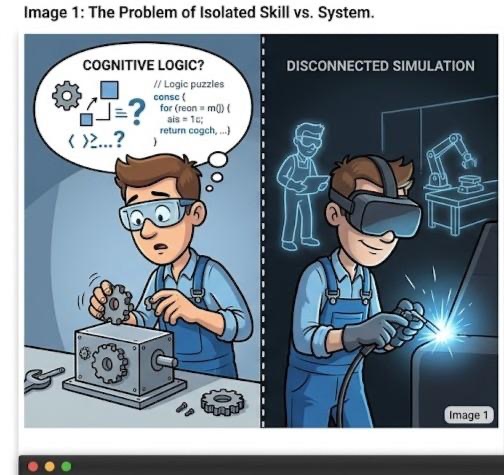
- One lives in their hands: Routing a cable through a tight enclosure. Feeling when a connector is properly seated. Soldering a wire.
- The other lives in their head: Network addressing, protocol configuration, firmware sequencing, system logic that offers little feedback until it either works or fails.
Traditional training separates these, and for good reason, motor skills are learned through practice, often by shadowing an experienced technician while cognitive skills are documented are learned abstractly. For edge device work, neither approach suffices alone.
Shadowing is slow and expensive and depends on experts who are already in short supply (and whose boss would prefer that they spent their time differently). Documentation captures procedure, but not judgment. It explains what to do, but not what “correct” looks like in practice, or how to recover when something breaks mid-process. This creates a structural gap.
Devices evolve faster than expertise. Variants accumulate. Firmware changes. Technicians move forward with partial knowledge and no efficient way to close the gap. An expert who could help might no longer be available. This is the problem addressed in XR5.0 Pilot 5, co-developed by SYN and SPACE Hellas.
The pilot focuses on an industrial IoT controller used in facility management. Complex enough to expose the problem, but representative enough to make the solution broadly relevant.
The key question is simple:
Can training environments handle both the physical and the procedural aspects of work at the same time?
The solution is a VR training application where the technician performs an assembly task inside a fully interactive 3D environment.
The device is not shown as a diagram, but as a manipulable object. It can be inspected, rotated, and handled spatially. Training content is delivered as structured objectives, guiding the technician through the process.
Crucially, physical and cognitive tasks are not separated. They occur together, as they do in real work.
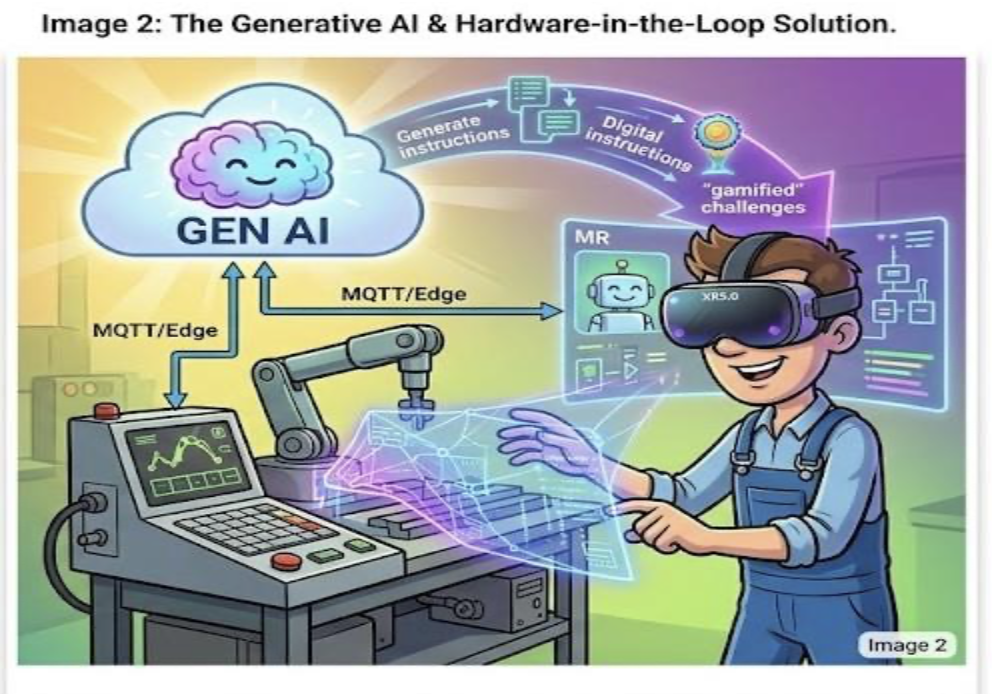
What distinguishes this from a standard XR training scenario is its connection to real hardware. Through MQTT integration, the VR environment communicates bidirectionally with an actual physical controller.
- A configuration step in VR triggers a real response from the device
- Sensor readings reflect the real system state
- Actions in training produce actual system behaviour
This is not a simulation that precedes real work.
It is the work executed through a different interface. That distinction matters most for procedural knowledge. The feedback loop between action and result is no longer abstract or delayed. It is immediate and grounded in the real system. For motor-cognitive tasks, the gap between knowing and doing has always been expensive to close.
- Documentation reaches the cognitive side but misses the physical
- Apprenticeship reaches both but does not scale
XR, when connected to real systems rather than isolated simulations, offers a third path. It keeps the task whole.
Training becomes less about preparation and more about controlled execution. The relevance extends beyond a single device. Industrial environments are full of programmable controllers, sensors, and embedded systems, and the same pattern appears repeatedly:
- Specialist knowledge concentrated in a few individuals
- Documentation that fails to transfer judgment
- Training cycles that cannot keep up with system evolution
With AI, the cost of creating training scenarios is also dropping. Generative models, trained on device manuals and procedural documentation, can assist in producing varied training scenarios, turning static instructions into interactive learning experiences.
Pilot 5 demonstrates one instance of a broader approach. Not replacing expertise but compressing the distance between access to knowledge and the ability to act on it.