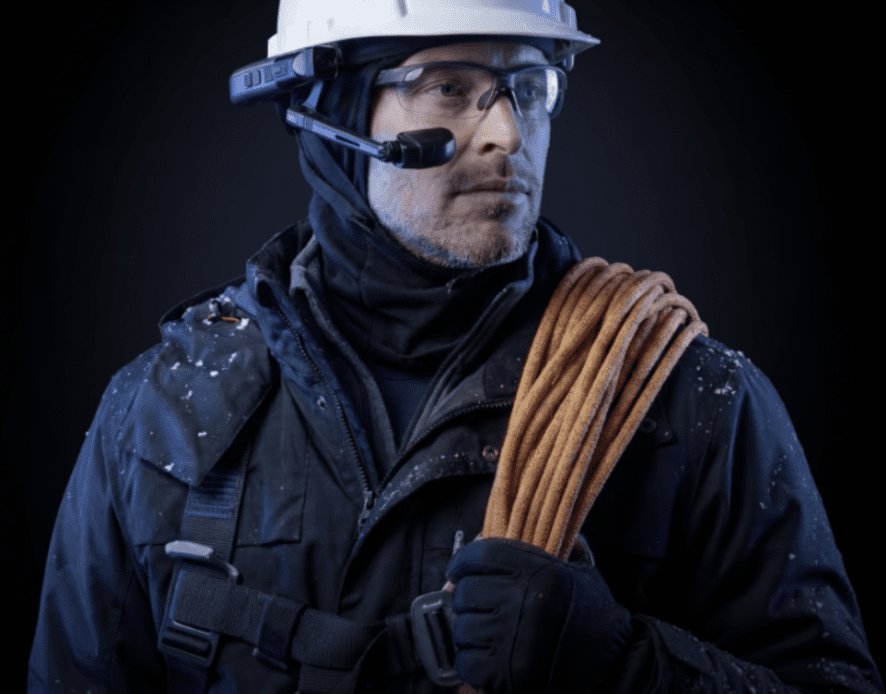
When people think about AR for frontline work, they usually picture the headset. That makes sense; the device is the thing a technician puts on every morning. But the headset is just one piece of a much larger system. At RealWear, we’ve built Ari OS as a complete operating system for B2B AR glasses, purpose‑built for frontline workers in industries like manufacturing, energy, automotive, and healthcare. What makes it work is not any single feature; it’s how five distinct components come together into one connected platform.
The first component is the device itself: the AR headset running Ari OS. Whether it’s a RealWear Navigator for heavy industrial environments or the lighter Arc 3 for logistics and clinical settings, the on‑device experience is built around voice‑first interaction. Workers speak naturally to Ari, our AI assistant, which is embedded at the system level. Ari doesn’t just answer questions; it controls device settings like brightness and volume, opens applications, places calls through RealWear Collaborate, and walks users through task‑specific workflows. A technician can say “Hey Ari, pull up the inspection checklist” and it appears in their field of view, hands-free. That kind of deep system access is what separates Ari from a simple chatbot sitting on top of an interface.
The second component is the Companion App for iOS and Android. Think of it as a remote control and management tool that lives on the worker’s phone. Through the Companion App, users can steer their AR device, chat with Ari directly, and handle media management: transferring photos, videos, and files between the headset and the phone. For workers who need to quickly review captured images or share documentation with a colleague, this bridge between the headset and a mobile device is essential.
The third component is the Web Portal: a full desktop interface where users can interact with Ari from a browser, manage files, adjust settings, and sync data across devices. This matters because not every interaction needs to happen on the headset. A shift supervisor reviewing yesterday’s inspection data, or a technician preparing for tomorrow’s job, can log in from a laptop and access the same AI, the same files, and the same settings that live on the device. The experience stays consistent whether you’re wearing the glasses or sitting at a desk.
The fourth component is the User Cloud: the personal hub that ties everything together for each individual worker. AI memory and context, files and documents, photos and videos, device settings, and chat history all live here. When a worker picks up a different headset or moves to another job site, their setup follows them. Ari uses this stored context to deliver better responses over time, because it remembers what that specific user has worked on, asked about, and configured before. The User Cloud is what makes the system feel personal rather than generic.
The fifth component is the Business Cloud: the enterprise control hub. This is where IT administrators and operations managers run the show at scale. Fleet management, mass deployment of apps and firmware updates, usage analytics, and security policies are all handled through a single web‑based console. For companies with hundreds or thousands of deployed headsets across multiple regions, this centralized control is what makes the difference between a pilot project and a real production rollout. A fleet manager can ensure every device has the correct configuration, the right apps, and the latest security policies, without touching a single headset.
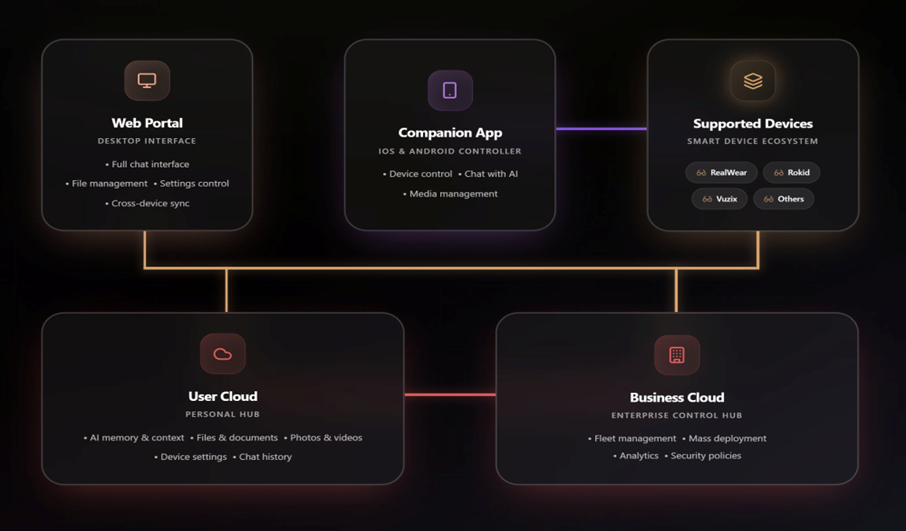
What makes Ari OS different from other approaches in this space is how these five components work as one system. The device captures data and runs AI, the Companion App extends control to the worker’s phone, the Web Portal brings the full experience to a desktop, the User Cloud keeps everything personal and synchronized and the Business Cloud gives the enterprise visibility and control over the entire fleet. Each component is useful on its own, but together they form a platform that scales from a single technician to a global deployment.
This architecture also supports a growing ecosystem of devices beyond RealWear’s own hardware. Ari OS is designed to run on AR and AI glasses from multiple manufacturers, which means enterprises aren’t locked into a single hardware vendor. The same software, the same AI, and the same cloud management tools work across the device ecosystem.
This integrated, device‑to‑cloud approach is closely aligned with the goals of the XR5.0 project, which focuses on developing human‑centric, AI‑driven XR applications for Industry 5.0. The XR5.0 vision calls for technology that adapts to workers rather than the other way around, and that’s exactly what a unified platform like Ari OS is built to deliver.