Pilot 5 Enters Its Final Stretch
As the XR5.0 Horizon Europe project moves into its final phase, Pilot 5, a collaboration between SPACE HELLAS and SYN, is shifting its focus from building technology to understanding what it means for the people who use it. The pilot addresses the assembly, configuration and repair of edge devices that monitor and control physical security infrastructures, such as alarm and access-control systems. These tasks demand precision and specialised knowledge, and mistakes can lead to downtime or compromised security. This post looks at the latest progress of the pilot, how it is being tested with real hardware, and what we have learned so far.
Two Complementary Use Cases
The first use case, Personalized Training for Edge Device Assembly, lets technicians practise assembly procedures in immersive VR on Meta Quest headsets before touching the real hardware. The second, Remote Instructions for Edge Device Repairs, supports technicians in the field with AI-assisted XR guidance for diagnostics, commissioning and fault resolution. In both cases, the level of detail adapts to the user: beginners receive step-by-step walkthroughs, while experienced technicians get concise prompts that do not slow them down.
From Components to an End-to-End Experience
Recent work has focused on bringing the XR5.0 building blocks together into one coherent workflow: workers’ data analytics, Human Digital Twins, personalized XR content, cloud-based training repositories and Hololight Hub integration. As a result, a technician’s profile can inform both the training they receive and the support offered later during repairs. Several user stories of the pilot have already reached Technology Readiness Levels between 4 and 6, reflecting the successful integration and validation of core functionalities.
Putting the Pilot to the Test
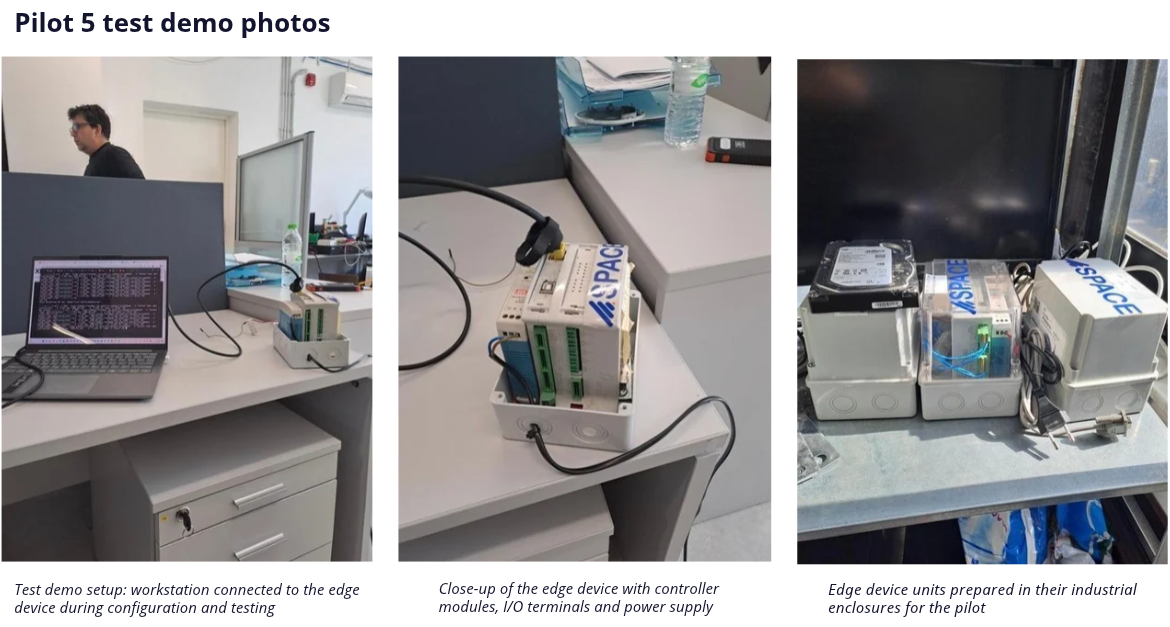
A key step in this phase was a test demo using the actual edge devices. In the lab, the devices were prepared inside their industrial enclosures, with controller modules, I/O terminals and power supplies in place, and connected to a workstation used to configure them and verify their operation. The aim was to confirm, end to end, that the physical hardware and the XR workflows work together as intended: that the guidance shown in XR matches what technicians will actually encounter in the field, and that the device status and diagnostic data feed correctly into the remote repair scenario. Running these steps on real equipment also reveals practical details that are easy to miss in a purely virtual setting.
Lessons Learned
Working closely with technicians has highlighted several lessons that are relevant well beyond this pilot. First, personalization matters: content that matches a technician’s experience level keeps users engaged. Second, lightweight headsets combined with cloud-based streaming make deployment realistic for companies with limited IT resources. Third, Human Digital Twins that consider indicators such as engagement or stress must be designed with transparency, consent and data protection in mind. Finally, involving end users early and often, as in the hands-on demo session with technicians in November 2025, is essential for refining content and interaction design.
What Comes Next
The coming months will focus on the final validation of the pilot and the assessment of its KPIs, including a reduction of more than 20% in assembly and repair times and increased engagement of lower-skilled technicians by more than 50%. In parallel, the team is exploring how the solution can be transferred to other types of industrial equipment and exploited beyond the lifetime of the project. By putting technicians at the centre of the design, Pilot 5 shows that XR and AI can make complex industrial work safer, more accessible and more efficient. We look forward to sharing the final results of XR5.0 in the coming months!