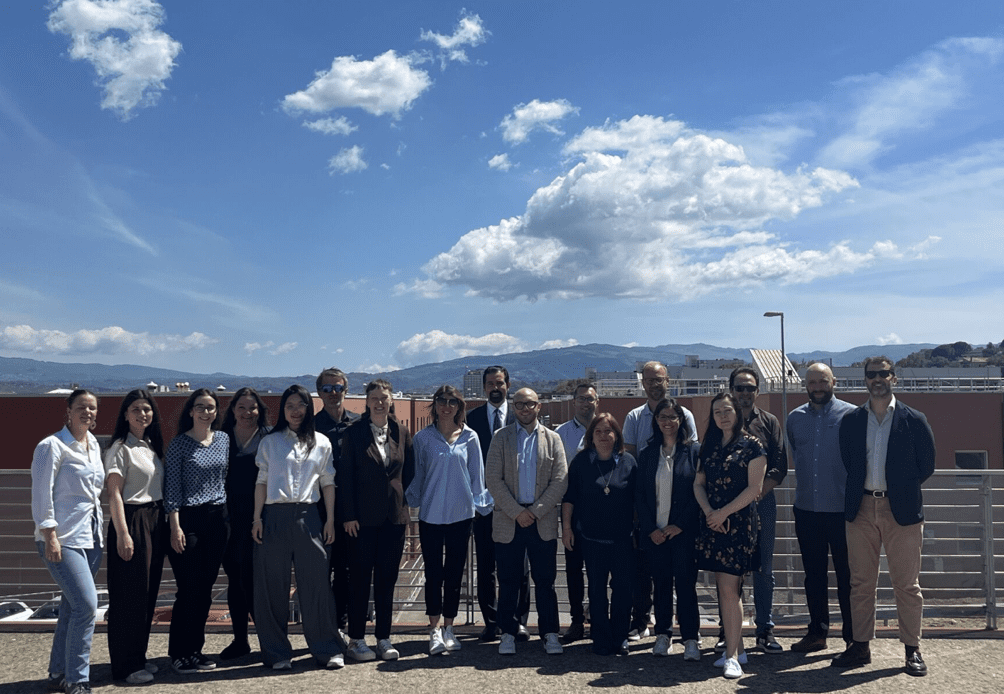
The evolution of the industrial landscape toward human centricity has moved beyond theoretical frameworks into active, multi-disciplinary implementation. At the core of this transition is the Operator 4.0 paradigm, which envisions a worker supported by advanced digital technologies to enhance physical, sensorial, and cognitive capabilities. To navigate this complex evolution, many European researchers, industry experts, and academic pioneers in human-centered manufacturing recently gathered at the exclusive 3rd Operator 4.0 Symposium (Website), held on 4-5 May 2026 at the University of Calabria (IT).
The event brought together several participants from several European research institutes, fostering a focused, high-quality exchange on the future of human-centric production. For SUPSI, participation in this elite forum represented a strategic milestone for the XR5.0 project, facilitating high-level dissemination and fostering critical alignment with the latest European research trends. The Symposium provided a unique environment for SUPSI to present the core objectives and mid-term results of the work done in the XR5.0 project.
Advancing the Dialogue on Human-System Integration
A significant portion of the dissemination focused on the technical and ethical challenges of creating truly adaptive industrial environments. Building on the project’s ongoing research on human-centred interaction design, SUPSI presented how Adaptive User Interfaces (AUIs) can address the limitations of traditional static interfaces in high-pressure manufacturing contexts, where operators’ cognitive load, stress levels, and contextual conditions continuously evolve. The dialogue at the Symposium centered on how these interfaces must dynamically adjust to user skill levels, task complexity, and real-time operational needs to improve safety and usability. At the core of these discussions was the role of the Human Digital Twin (HDT).
SUPSI presented Clawdite, an IIoT-based platform designed to manage the highly dynamic human-related information necessary for these twins. Beyond its modular architecture, which integrates real-time data from wearable sensors, eye-tracking devices and machines to build a comprehensive “digital avatar” of the worker, the dissemination also covered the functional modules currently available on the platform, including the ones created within the XR5.0 project, such as fatigue estimation, skills and capabilities matching, trajectories prediction, and workers’ activity monitoring. Alongside the technical contribution, SUPSI also presented its most recent project-related publications, providing concrete evidence of the research outcomes generated within XR5.0 and reinforcing the scientific impact of the consortium’s work. By presenting these concepts to the research network, SUPSI contributed to the European-wide effort to standardize how human traits are embedded into the architecture of smart manufacturing systems.
Cross-Pollination and Project Benefits
Participation in the Symposium generated concrete value for the XR5.0 project, both in terms of dissemination and technical exchange. The event provided an opportunity to present the vision and ongoing developments of XR5.0 to a focused community of European researchers, with particular attention to the current evolution of Clawdite and its role as an enabling platform for future human-centric XR and HDT applications. Sharing direct access to the platform and discussing its development roadmap opened initial contacts for potential future collaborations with research groups working on complementary challenges.
The discussions also offered targeted input for the project’s pilot activities. In particular, exchanges around predictive modelling for human movement and adaptive monitoring approaches provided useful perspectives for refining scenarios such as robot-aware human motion forecasting in Pilot 1 and stress-aware training adaptability in Pilot 5. These interactions helped contextualise the technical developments within broader European industrial needs and highlighted methodological aspects worth further exploration.
Beyond dissemination, the Symposium represented a valuable moment of mutual learning. The small and highly specialised format enabled direct comparison with other European initiatives, giving SUPSI the opportunity to discuss ongoing pilot implementations, compare methodological approaches, and identify shared research questions. Presenting open challenges and planned next steps as part of XR5.0’s roadmap also helped position these topics as potential entry points for future joint work on next-generation human-centric XR solutions.
Conclusion
The 3rd Operator 4.0 Symposium 2026 was more than a technical workshop, it was a strategic venue for ensuring that the XR5.0 project remains deeply integrated into the European research fabric. Through the dissemination of its AI-enabled XR paradigm and the Clawdite platform, SUPSI has helped reinforce the project’s commitment to a human-centric Industry 5.0.
Authors: Davide Matteri, Sara Masiero, Vincenzo Cutrona, Elias Montini, Samuele Dell’Oca (SUPSI, SPS lab)