
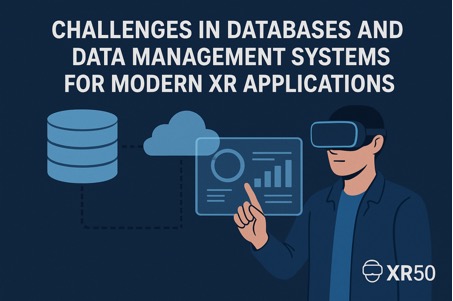
The world of Extended Reality (XR) brings compelling new opportunities: immersive training, remote collaboration, digital twins, 3D holographic communication, location-aware AR experiences, and more. But these advances also impose demanding requirements on the underlying data infrastructure. XR applications tend to generate large volumes of heterogeneous data (sensor streams, user interactions, spatial tracking data, telemetry, state synchronization), at high velocity and often with real-time / low-latency constraints. Managing, storing, querying, and making sense of this data, often across distributed, edge and cloud environments, challenges traditional database systems.
XR systems typically produce a continuous stream of data: user movements, head/ hand tracking, spatial anchors, telemetry from sensors, environment mapping updates, state changes, often for many concurrent users.
This creates a classic “velocity” challenge: the data ingestion rate may spike dramatically (e.g. when many users interact, or a scene rapidly changes), requiring a system capable of absorbing many writes per second without becoming a bottleneck. Traditional relational databases often struggle under such workloads: write operations may be slow due to I/O, indexing, concurrency control, and transaction overhead. As a result, XR developers sometimes rely on NoSQL, time-series, or custom data stores, but those come with trade-offs in query flexibility, consistency, or integration complexity. A database designed for high ingestion velocity and massive throughput is critical for XR backends.

XR applications often demand real-time processing: whether for synchronizing state between users in a shared virtual environment, responding to sensor or user input, providing analytics or telemetry dashboards, or updating spatial anchors and environmental data. Latency must remain low to preserve interactivity and immersion. Moreover, building meaningful XR experiences may require combining real-time data with historical data: for example, aggregating user interactions over time, analytics on usage patterns, or performing spatial queries referencing previously stored environment data. Achieving real-time ingestion and real-time analytics over large volumes of data is notoriously difficult. Many traditional systems separate “operational” databases (for fast writes) from “analytical” databases/warehouses (for complex queries), requiring data pipelines or nightly ETL jobs, which introduces delays, increases complexity, and reduces freshness.

XR projects often start small, a pilot, a proof-of-concept, a limited user base, but if successful, they may scale to many concurrent users, or be deployed globally. This growth implies a dramatic increase in data volume (space, interactions, telemetry) and load (concurrent reads/writes, analytics, queries). Traditional relational databases may scale vertically (bigger server), but vertical scaling hits limits quickly. Scaling out introduces complexity, risks of inconsistency, and maintenance overhead. On the other hand, purely NoSQL solutions often sacrifice transactional integrity, query flexibility, or strong consistency guarantees. XR data systems that fail to scale gracefully risk breakdowns, high latency, uneven performance, or unsustainable operational loads, all detrimental to user experience and product reliability.
XR data is not uniform. A single XR application might store: positional tracking data, spatial mapping / 3D environment data, user profiles and preferences, interaction logs, time series telemetry, analytics data, possibly geospatial data (for location-based AR), and metadata. Queries over this data can be complex: temporal queries, spatial queries, aggregation across different data types, joins across user, session, environment, historical archives, analytics & summary tables. Many NoSQL stores lack the expressive power to perform complex joins, relational queries, or efficient aggregations. This leads developers to combine multiple data stores, e.g. one store for time-series telemetry, one for user data, one for spatial indexes, another for analytics, complicating architecture, increasing maintenance overhead, and fragmenting data view. Given how dynamic XR applications are, such data heterogeneity is the rule, not the exception.
In distributed, globally deployed XR systems, possibly spanning edge devices, cloud instances, multiple regions, ensuring data consistency and availability is challenging. Network partitions, server failures, write conflicts all become realistic risks. For XR experiences that require real-time collaboration or synchronized state across users, weak consistency can lead to divergent views, state corruption, or user confusion. Moreover, for analytics or audit use cases, losing data or having inconsistent records undermines reliability and trust. For production-grade XR services, you need a data system with strong consistency, reliable replication, high availability, and robust fault tolerance.Finally, many XR data workloads combine both high write volume (telemetry, streams) and complex reads (analytics, historical queries), which can stress concurrency control mechanisms, leading to contention, performance degradation, or even data loss in naive systems.

This is where LeanXcale enters the picture: a database engineered to address many of the above challenges, combining high ingestion rates, scalable distributed architecture, full SQL support, real-time analytics and operational workloads in a single system.
- High ingestion & throughput: LeanXcale uses a specialized storage engine (KiVi), optimized for fast writes, with a dual interface (key-value + SQL) that can ingest data efficiently even under heavy load.
- Real-time analytics & aggregation: Thanks to online aggregation and real-time KPI computation built into LeanXcale, it’s possible to ingest data and have aggregated metrics or analytics queries immediately available — avoiding separate data pipelines or batch processing delays.
- Scalable architecture — from small to large: LeanXcale is designed as a distributed, “shared-nothing” database, with its storage, transactional manager, and query engine all able to scale horizontally and independently. This avoids bottlenecks and supports growth from a single-node MVP to hundreds of servers.
- Full relational model + flexibility: Because LeanXcale is ANSI-2003 SQL compliant, supports JOINS, secondary indexes, covering indexes, and integrates with standard BI tools, you can store heterogeneous XR data and query it relationally — combining telemetry, user data, spatial metadata, historical logs, analytics tables — without mixing multiple different data stores.
- Simplified architecture & lower maintenance overhead: By consolidating operational workloads (real-time ingestion, transactional data) and analytical workloads (historical queries, KPIs, analytics) into a single database, LeanXcale reduces the need for multiple systems, ETL pipelines, or complex orchestration — which lowers total cost, reduces architectural complexity, and speeds up development/troubleshooting.
- Reliability & high availability: LeanXcale offers active–active high availability, replication, hot/cold backups, encryption, access control, essential features for production-grade XR services with critical data or compliance requirements.
Thus, for XR projects, from research prototypes to large-scale deployments, LeanXcale provides a data backbone that aligns well with XR’s demanding requirements of velocity, variety, latency, scalability and consistency.
As XR applications mature, from experiments and prototypes to production-ready systems, multi-user platforms, and global-scale deployments, the demands on data management grow considerably. High ingestion rates, real-time analytics, large and heterogeneous data volumes, spatial and temporal complexity, scalability, and strong consistency are not optional: they are prerequisites for delivering good user experience, reliability, and maintainability.
In this context, choosing a data management system that is purpose-built to handle high throughput, scalable distributed workloads, real-time analytics and flexible querying is a strategic decision. A database like LeanXcale aligns well with these demands: by offering a unified, scalable, ACID-compliant SQL database that can function both as operational and analytical backend, LeanXcale can significantly reduce architectural complexity, improve performance, and future-proof XR data infrastructures.