
The convergence of Artificial Intelligence (AI) and eXtended Reality (XR) is opening a new design space for Industry 5.0 applications. AI provides capabilities for perception, reasoning, prediction, explainability and knowledge retrieval, while XR offers immersive and context-aware interfaces through which these capabilities can be integrated directly into industrial workflows.
The central challenge is no longer whether AI and XR can coexist within the same system. The more important question is how they can be integrated in a way that makes intelligence contextual, interpretable and actionable for industrial users.
This is the direction explored by the XR5.0 project. The project investigates AI–XR symbiosis as a coordinated interaction between intelligent services, immersive interfaces and human expertise, with the objective of supporting transparent, adaptive and effective decision-making in Industry 5.0 environments.
XR5.0 combines advanced AI approaches, including Neurosymbolic AI (NSAI), eXplainable AI (XAI), Active Learning and Generative AI, with XR-based visualisation, interaction and training mechanisms. These technologies are not treated as isolated components. Instead, they are integrated through architectures and interfaces that enable AI-generated insights to be delivered according to the needs of the user, the task and the operational context.
Beyond AI outputs
In industrial applications, the value of AI extends beyond the accuracy of its predictions. A recommendation may have limited practical value if it is delivered without sufficient context, supporting evidence, or alignment with the current stage of the workflow. XR can address this by embedding AI-generated information directly within the operational setting and associating it with the relevant assets, processes, and decisions. This creates an important shift: from simply displaying AI results to providing situated intelligence.
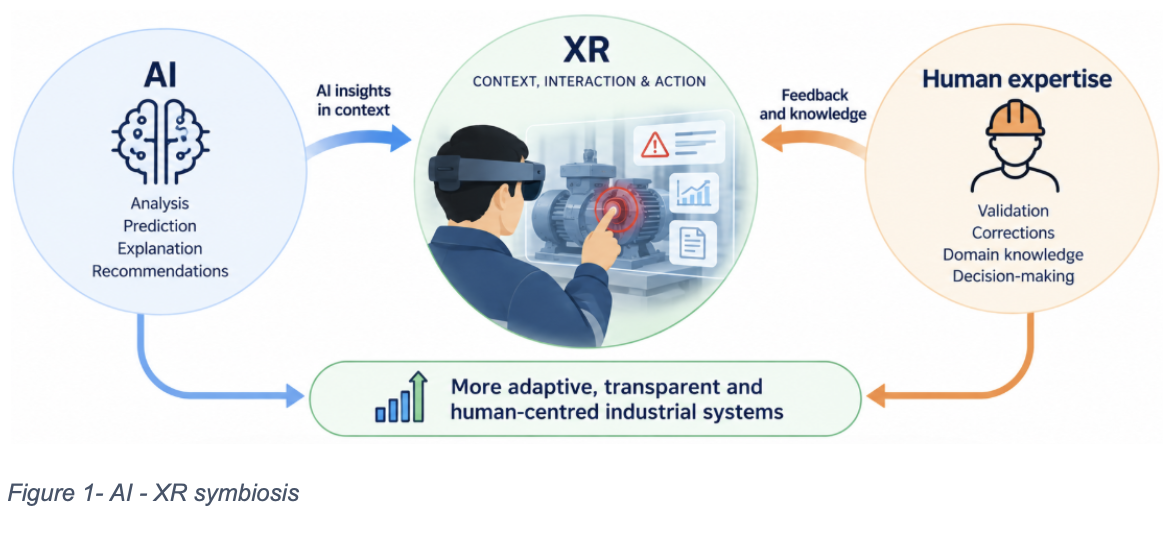
For example, AI-detected anomalies can be associated directly with the relevant physical asset, while recommendations can be incorporated into specific stages of a maintenance or inspection procedure. Explanations may be enriched with visual evidence, technical documentation, or contextual information and delivered through spatial visualisations, voice-based interaction, or other multimodal XR interfaces.
The effective coordination of these capabilities depends on a robust AI–XR integration layer. This layer enables the exchange and contextualisation of information between AI services and XR applications, while ensuring that recommendations and explanations are presented according to the requirements of the user, task and operational environment.
The experience gained within the XR5.0 project indicates that this integration is fundamental to transforming independent AI and XR technologies into coherent, human-centered industrial solutions.
Making intelligence understandable
Explainability becomes particularly relevant when users are expected to assess AI-generated recommendations rather than simply receive them. In such settings, the objective is to provide sufficient insight into the basis of a recommendation so that users can interpret, verify, and act upon it with greater confidence.
XR5.0 investigates several approaches for presenting AI explanations in forms that are appropriate to different industrial contexts. In inspection-related scenarios, explanations can be associated with visual evidence, technical documentation, and concept-level reasoning. In conversational applications, AI responses can be complemented by structured reasoning, retrieved information, and contextual references.
An important outcome is that explainability should be adapted to the characteristics of the task and the interaction environment. There is no single representation that is equally suitable for all XR applications. Spatial and visual explanations may be more appropriate for inspection activities, whereas concise conversational or voice-based explanations may better support maintenance and training workflows. This also points to a broader research direction: XR can evolve from being a channel for presenting AI outputs into an interactive environment through which users can examine, question, and engage with the reasoning processes of AI systems.
From assistance to collaboration
The value of AI–XR symbiosis increases further when interaction is designed as a two-way process rather than a one-directional delivery of AI outputs. Through Active Learning and Human-in-the-Loop mechanisms, users can validate system results, correct inaccurate predictions, provide annotations, and contribute domain-specific knowledge. In this way, human expertise becomes directly involved in the continuous refinement and adaptation of AI models.
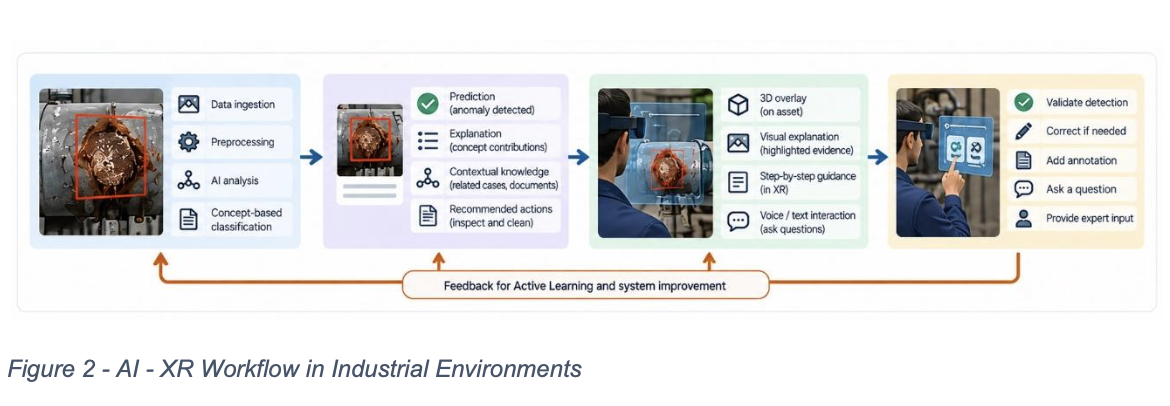
XR5.0 demonstrates this approach in Neurosymbolic inspection scenarios, where automated analysis is combined with concept-based reasoning and expert input. This enables domain specialists to review AI-generated results, provide corrective feedback, and contribute knowledge that can improve subsequent system behavior.
Such interaction is especially valuable in industrial contexts where labelled data may be limited and expert knowledge remains critical. XR serves as the interaction environment that connects AI perception, explanation, human judgement and feedback within a single operational workflow. This creates the basis for a more collaborative form of intelligence, in which both AI capabilities and human expertise contribute to the evolution of the overall system.
Why does this matter?
One of the main contributions of XR5.0 project lies in its investigation of AI–XR integration across a diverse set of industrial environments, rather than within a single, fixed technological setting. This broader perspective allows the project to examine how different combinations of AI capabilities, XR technologies, and interaction modalities can support a range of operational activities, including training, maintenance, inspection, troubleshooting, and decision support.
XR5.0 demonstrates that the value of AI-enabled XR extends beyond technical feasibility. Across diverse industrial scenarios, the project examines usability, responsiveness, operational effectiveness, user experience, and system integration, while also identifying key challenges such as latency, interface design, interoperability, cognitive load and the effective coordination of multiple AI services. These challenges define important research directions for the next generation of intelligent industrial systems.
The objective is therefore not simply to advance AI models or XR applications independently, but to develop integrated systems in which AI provides analytical and reasoning capabilities, XR provides contextual and interactive access to those capabilities, and human expertise remains actively involved in interpretation, validation and adaptation. In this way, AI–XR symbiosis can provide a strong foundation for more adaptive, transparent, and human-centered Industry 5.0 environments.