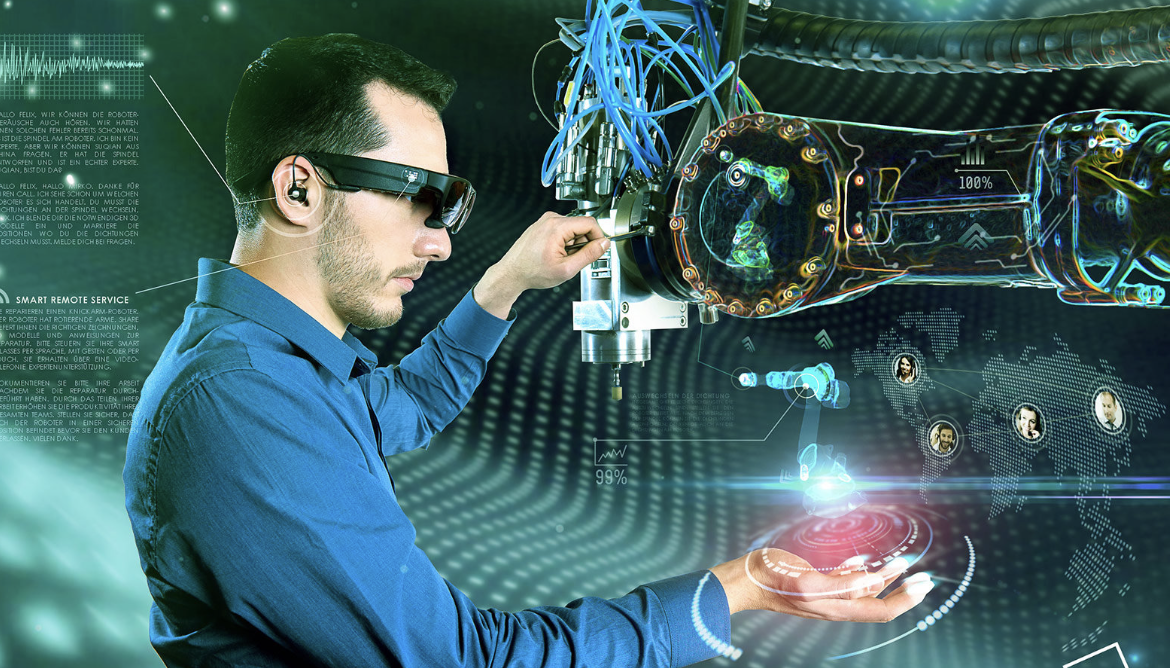
Smart glasses have been used in industrial research and pilot projects for more than a decade. Their central benefit has remained consistent: workers can access digital information while keeping their hands available for the physical task. Recent progress in artificial intelligence could now expand this concept considerably. Instead of functioning primarily as wearable screens, future smart glasses may become context-aware assistants that interpret the working environment and provide support for specific industrial workflows.
A recent systematic review of assisted-reality applications in manufacturing identifies maintenance, visual work instructions, remote assistance, monitoring and quality control as particularly relevant use cases. The review also highlights artificial intelligence, industrial Internet of Things integration and improved human-machine interaction as important areas for further development.
The combination of smart glasses and AI is especially promising because the two technologies provide complementary capabilities. Smart glasses can capture the worker’s visual perspective and present information within the field of view. AI can analyse images, speech, documents, sensor data and historical maintenance records. Together, these technologies can provide information that is more closely aligned with the current task.
Context-Aware Maintenance Support
Maintenance is one of the clearest application areas. A technician could look at a machine and ask the system to identify the asset, retrieve its maintenance history or display the correct service procedure. Computer vision could help recognise components, indicators or visible defects. An AI model could then connect these observations with equipment documentation, work orders and sensor data.
The system would not need to make autonomous maintenance decisions. Its role could be to organise relevant information, suggest diagnostic steps and explain why a particular action may be appropriate. The technician would remain responsible for evaluating the situation and approving the next step.
AI could also improve hands-free documentation. Spoken observations could be converted into structured maintenance notes, while images and videos could be assigned automatically to the correct asset and work order. Research into the integration of AI, speech processing and augmented reality has already explored hands-free task logging as a method for reducing interruptions during industrial maintenance.
Adaptive Work Instructions
Traditional digital work instructions usually follow a fixed sequence. AI-supported smart glasses could adapt instructions to the worker’s experience, the machine configuration and the current process state.
An experienced technician may only require a checklist and safety confirmation. A new employee may benefit from detailed explanations, visual examples and verification after each step. If the system detects uncertainty or a deviation from the expected process, it could provide additional guidance or recommend assistance from a supervisor.
This could be particularly valuable for assembly, inspection, changeovers and less frequently performed maintenance tasks. Instead of replacing employee expertise, the system could make existing organisational knowledge available at the moment it is required.
Quality Inspection and Process Documentation
Smart glasses could also support visual inspection workflows. A worker might examine a product while an AI model compares visible characteristics with reference images, specifications or known defect patterns. Potential deviations could be highlighted for closer inspection.
The final decision should remain with a qualified employee, especially in safety-critical or regulated environments. However, AI could help standardise documentation, ensure that required inspection points are not missed and make previous quality information easier to access.
Remote Expertise and Knowledge Transfer
Remote assistance is already one of the established applications of industrial smart glasses. AI could make this workflow more efficient by summarising the situation before a remote expert joins, retrieving relevant documentation and recording the final solution.
Over time, recurring support cases could become part of a searchable organisational knowledge base. This would allow knowledge created during one intervention to support future technicians facing similar problems. The combination of AI-enhanced digital twins, real-time industrial data and maintenance information could further strengthen this connection between the physical asset and its digital history.
From General Technology to Specific Workflows
The future of industrial smart glasses is unlikely to depend on a single device that supports every activity. Adoption may instead progress through clearly defined workflows in which hands-free access, visual context and AI-supported information retrieval provide measurable value.
Human-centred implementation will remain essential. Devices must be comfortable, compatible with protective equipment and integrated with existing industrial systems. AI-generated recommendations must be traceable, secure and easy to verify. Workers should also be involved in the design of the workflows that affect their daily activities.
This approach corresponds closely with the objectives of XR5.0. The project combines human-centred extended reality, artificial intelligence and digital twins to develop applications for areas including training, assembly guidance, troubleshooting and remote maintenance. Six pilot applications are being developed and evaluated in realistic manufacturing environments.
Smart glasses may therefore become most valuable not as replacements for computers, tablets or human expertise, but as a new interface between workers and industrial knowledge. When applied to carefully selected workflows, their combination with AI could make information more accessible, documentation more consistent and technical support more responsive.
Sources
Solomashenko, A. et al. “A systematic review of assisted reality applications in manufacturing.” Virtual Reality, Volume 30, 2026.
Chen, S. et al. “AI-enhanced digital twins in maintenance: Systematic review and future research directions.” 2025.
Khanna, P. et al. “Human-centric Maintenance Process Through Integration of AI, Speech, and AR.” 2025.