Transforming Industrial Training and Maintenance
The transition towards Industry 5.0 is redefining the relationship between humans and technology, placing workers at the center of digital transformation. Within the XR5.0 Horizon Europe project, Pilot 5 demonstrates how Extended Reality (XR), Artificial Intelligence (AI), Human Digital Twins, and intelligent training platforms can be combined to enhance the effectiveness, safety, and quality of industrial assembly and maintenance processes. The pilot focuses on the assembly, deployment, configuration, and repair of industrial edge devices used in security-critical environments. These devices play an important role in monitoring and controlling physical security infrastructures, supporting functions such as alarm activation, access control, and operational monitoring. While highly valuable, their installation and maintenance often require specialized knowledge, creating challenges for both inexperienced and experienced technicians.
Use Case 1: Personalized XR Training for Edge Device Assembly
The first use case focuses on Personalized Training for Edge Device Assembly. Technicians can access immersive training scenarios through Meta Quest devices, allowing them to interact with virtual representations of industrial equipment in a safe and controlled environment. Training content is adapted according to the technician’s experience level, providing detailed guidance to beginners while offering more concise instructions to experienced users.
By combining 3D visualizations, interactive workflows, and contextual documentation, the platform enables technicians to acquire practical skills before interacting with physical equipment. A key innovation of this use case is the integration of AI-driven personalization. Training scenarios are generated and adapted based on technician profiles, enabling individualized learning paths. The platform also incorporates Human Digital Twin technologies that consider indicators such as user engagement and stress levels, allowing the training experience to dynamically adjust its level of detail and support. This approach aims to improve learning effectiveness while maintaining user engagement throughout the training process.
Use Case 2: AI-Assisted Remote Support for Repairs
The second use case focuses on Remote Instructions for Edge Device Repairs. In this scenario, technicians receive intelligent support while performing maintenance and troubleshooting activities. Through XR interfaces, users can execute diagnostic procedures, identify faults, and receive contextual repair recommendations. AI-powered assistance helps technicians perform device commissioning, operation verification, and fault resolution more efficiently.
Building the Technological Foundation
Significant technical progress has been achieved during the latest project period. The pilot currently exploits several XR5.0 technological building blocks, including workers’ data analytics, Human Digital Twins, personalized XR content development, cloud-based XR training repositories, training material management services, Hololight Hub integration, and XR training programs. Together, these components create a complete ecosystem capable of supporting adaptive industrial training and maintenance workflows. The integration of AI services, XR applications, cloud-based content repositories, and connected edge devices enables a seamless training and support experience that can be scaled across different industrial environments.
Progress Towards Key Performance Indicators
The pilot has demonstrated tangible progress in terms of maturity and readiness. Several user stories have already reached Technology Readiness Levels (TRLs) between 4 and 6, reflecting successful integration and validation of core functionalities. These developments contribute directly to the pilot’s targeted Key Performance Indicators, including a reduction of assembly and repair times by more than 20%, increased engagement of lower-skilled technicians by more than 50%, and significant reductions in operational costs. The achieved results indicate that personalized XR and AI-assisted workflows can deliver measurable improvements in workforce performance and operational efficiency.
Validation Through Real Demonstrations
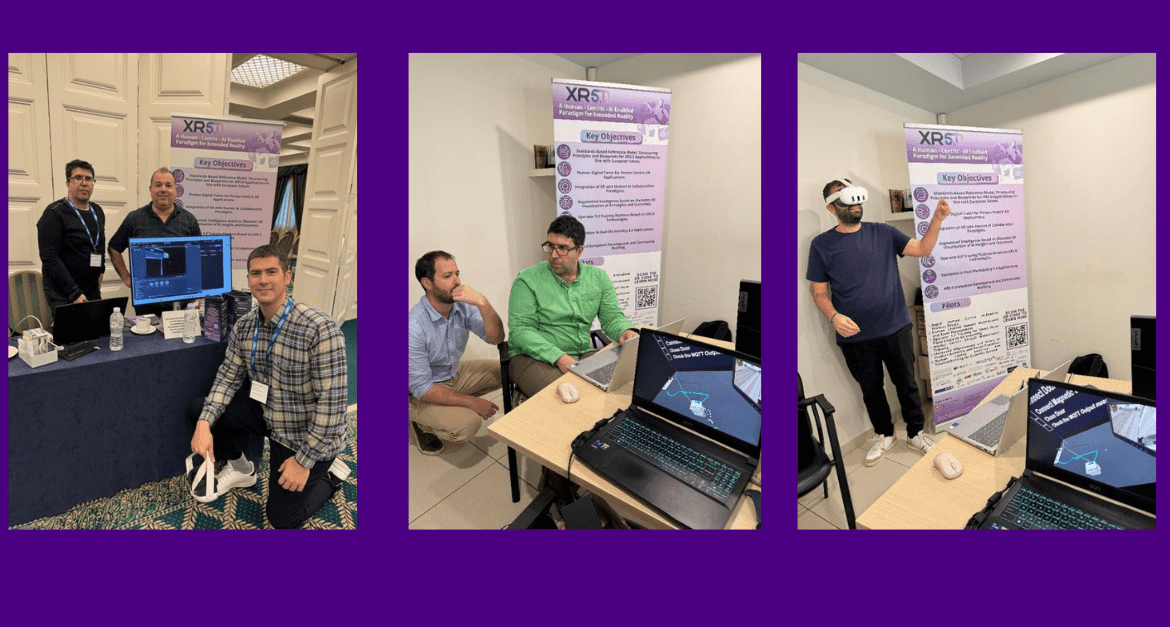
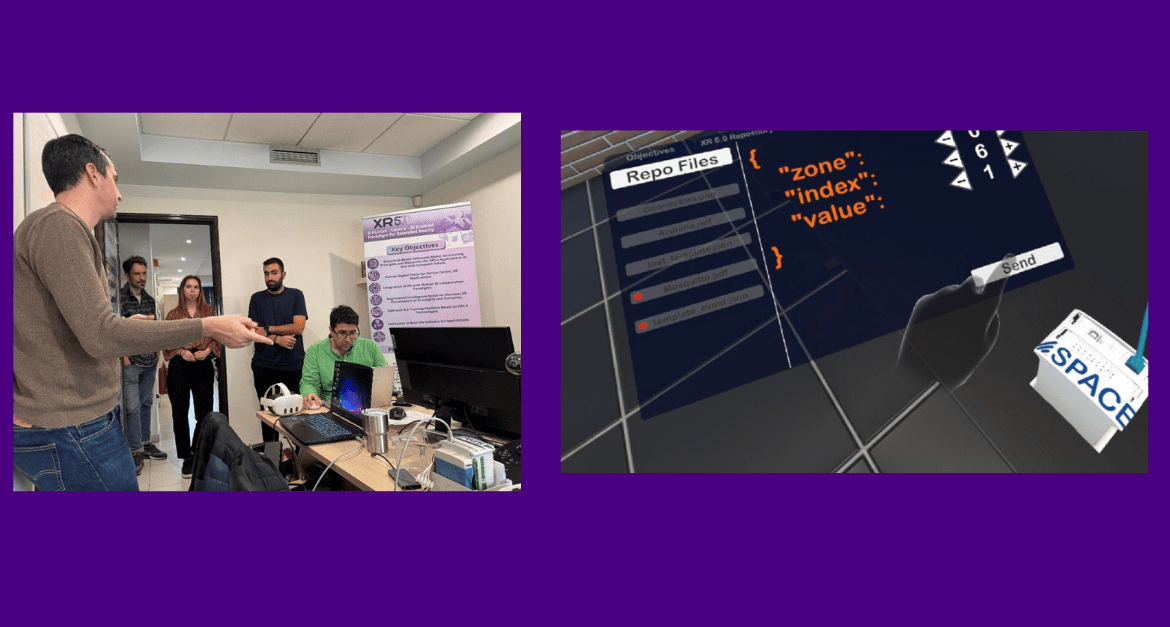
Beyond technical development, Pilot 5 has also been actively validated through dissemination and demonstration activities. In November 2025, a live demonstration session was organized with technicians who experienced hands-on XR training using Meta Quest devices. Participants explored personalized assembly and repair workflows, gaining practical experience with immersive learning and AI-assisted maintenance support. Feedback from the session confirmed the potential of XR technologies to improve technician familiarization, operational confidence, and remote assistance capabilities. The pilot has additionally been presented to the wider research and innovation community through a demonstration paper at the IEEE NFV-SDN 2025 Conference in Athens, highlighting the application of XR technologies to industrial assembly and repair processes.
Towards a Human-Centric Industry 5.0 Future
By combining immersive XR experiences, adaptive AI, Human Digital Twins, and intelligent maintenance assistance, Pilot 5 provides a compelling example of how Industry 5.0 technologies can support both organizational objectives and workforce development. The pilot showcases how digital innovation can be applied in a practical and measurable manner, creating safer workplaces, supporting continuous learning, and enabling technicians to perform complex tasks with greater confidence and efficiency. As XR and AI technologies continue to mature, their role in shaping the future industrial workforce is expected to become increasingly significant.