
The XR5.0 project is now entering its final year, making it particularly important to ensure that all project activities remain fully aligned with evolving legal and ethical standards. Over the past few years, the European regulatory landscape for artificial intelligence and digital technologies has undergone significant transformation. One of the most important developments is the adoption of the EU Artificial Intelligence Act, which establishes a comprehensive risk-based framework for the development and deployment of AI systems across the European Union. In parallel, the European Commission has introduced broader regulatory simplification initiatives, including the so-called Digital Omnibus packages, which aim to streamline and clarify the application of existing digital legislation while maintaining strong safeguards for fundamental rights, safety, and transparency.
For research and innovation projects such as XR5.0, these developments are particularly relevant. The Digital Omnibus initiative seeks to reduce regulatory fragmentation and improve coherence between different digital regulatory instruments, including the AI Act, the Digital Services Act, and the Data Act. By clarifying obligations and reducing unnecessary administrative burdens, these reforms are intended to support innovation while ensuring that emerging technologies remain trustworthy, safe, and aligned with European values. For XR5.0, this evolving framework reinforces the importance of embedding ethical and legal considerations directly into the design, testing, and deployment of extended reality (XR) technologies and AI-driven systems.
Against this evolving regulatory background, the XR5.0 consortium has taken a proactive approach to legal and ethical compliance. Rather than treating compliance as a final checkpoint, the project integrates ethical reflection and regulatory alignment throughout the entire lifecycle of the pilots. This approach reflects the principle of ethics by design, ensuring that ethical safeguards and legal requirements are embedded from the earliest stages of system development.
To support this effort, the project relies on the European Commission’s Ethics Guidelines for Trustworthy AI. In particular, the seven key requirements identified in the Assessment List for Trustworthy Artificial Intelligence (ALTAI) serve as the conceptual backbone of our evaluation framework. These principles provide a flexible yet robust structure for assessing AI systems, covering dimensions such as human agency and oversight, technical robustness and safety, privacy and data governance, transparency, diversity and fairness, societal and environmental well-being, and accountability.
From a methodological perspective, the assessment combined several complementary approaches. All pilot partners completed structured ALTAI self-assessment questionnaires, which were complemented by targeted interviews and a review of relevant technical and governance documentation. The evaluation included mapping of data flows within the pilots, identification of potential indirect identifiers in datasets, and verification of documentation related to the model lifecycle. Particular attention was paid to the existence of human oversight procedures, logging mechanisms, audit trails, and risk management processes.
This work has been carried out within Work Package 1, Task 1.4, and has been conducted in close collaboration with the project’s Ethics Advisory Board. Their involvement ensures that the assessment does not remain purely theoretical but instead directly informs both day-to-day engineering practices and higher-level governance decisions across the consortium. The analysis also complements Deliverable 1.5, Ethical Management and Regulatory Compliance Framework, by translating high-level ethical principles into concrete operational guidance that partners can apply during design, testing, and pilot deployment.
Key Findings and Looking Forward
The review of the pilot activities revealed a generally strong commitment among partners to responsible AI development. Many teams have already taken important steps to clarify the role of human oversight in AI-assisted decision-making processes, and several pilots demonstrate early integration of privacy-by-design principles in their technical architecture. In addition, documentation practices for datasets and models have been taken into account, reflecting a growing awareness of the importance of transparency and traceability in complex AI pipelines.
Ensuring trustworthy and responsible AI is not a one-time exercise but a continuous process that must evolve alongside technological development and regulatory change. For this reason, the XR5.0 consortium views compliance not as a static requirement but as an ongoing commitment to responsible innovation.
As the project approaches its final phase, the consortium will continue refining its ethical and regulatory framework, updating the ALTAI self-assessments, and strengthening governance practices across the pilots. Ultimately, XR5.0 seeks to demonstrate that innovation and responsibility can advance together. By embedding transparency, accountability, and human oversight into the design of emerging XR technologies, the project aims to help build systems that are not only technically advanced but also socially trustworthy. In doing so, XR5.0 contributes to the broader European vision of human-centric digital transformation, where technological progress supports fundamental rights, societal well-being, and sustainable innovation.

Technological advancements are revolutionizing how we perform tasks, enabling them to be completed faster and with greater precision. Digital transformation has become a cornerstone for any company aiming to scale sustainably and create a positive impact within XR (Extended Reality). In industrial environments, efficiency and precision are essential, especially for tasks like equipment maintenance or everyday repairs. This is where XR technology plays a crucial role, adding practicality and value by improving operational efficiency and accuracy.
ALMER, now part of RealWear, is at the forefront of this transformation through its use of Augmented Reality (AR) devices specifically designed for industrial applications. By tailoring its solutions to meet the diverse needs of workers, RealWear integrates AR software and advanced artificial intelligence (AI) into devices that simplify industrial workflows. As a result, complex tasks become simpler, faster, and more accessible.
In 2024, ALMER (now RealWear) introduced ARI (Augmented Reality Intelligence), a new AI assistant optimized for AR devices. ARI showcases how RealWear’s ARC 2 technology can streamline processes, even for seemingly simple tasks like installing a bike rack.
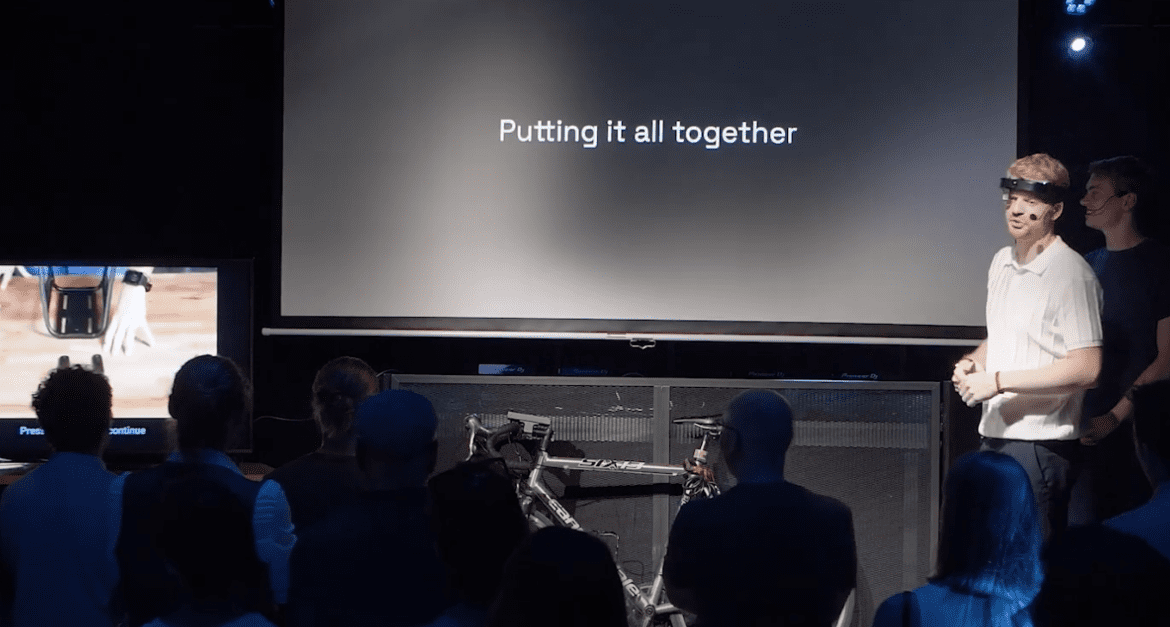
During our ARmazing event 2024 (see video), ARI was put to the test by providing step-by-step instructions for installing a bike rack on a bicycle not designed for one – a task that typically requires specialized knowledge, the right tools, and often professional assistance. Thanks to voice commands and hands-free functionality, users can interact with ARI in real time, ask questions, and receive immediate responses.
For example, when asked about the cost of installing a bike rack in Bern, Switzerland, ARI quickly processes the request and provides an estimate based on the user’s location. This ability to deliver contextualized information is vital for companies operating across multiple regions.
When the user requests installation instructions, ARI responds with a detailed video tutorial. Using the RealWear ARC 2 device, the user can view the video overlaid within their field of vision, allowing them to follow instructions hands-free, reduce errors, and work more efficiently.
If the first tutorial is not sufficient, the user can request another one, and ARI will quickly provide an alternative, showcasing its adaptability to user preferences. This flexibility is crucial in industrial settings, where workers have varying levels of experience and learning styles.
If the task proves too complex, the user can search for a nearby repair shop using ARI. Additionally, ARI automates communication by allowing users to send emails to service providers requesting quotes, demonstrating its ability to streamline routine tasks and boost productivity.
ARI’s Integration with RealWear and Oculavis
The collaboration between RealWear and platforms like Oculavis (part of the XR5.0 project), along with ARC 2’s integration with Microsoft Teams, is elevating remote assistance to new levels.
- RealWear Navigator and ARC 2: These robust, hands-free hardware devices are ideal for industrial environments. Their integration with remote assistance software allows technicians to access real-time guidance, collaborate with remote experts, and perform tasks more efficiently.
- Oculavis: This platform features advanced AR capabilities such as interactive 3D models and AI-driven diagnostics, offering a comprehensive solution for remote maintenance. It is particularly useful for workflows requiring step-by-step guidance and structured processes.
- Microsoft Teams Integration with ARC 2 and ARI: Designed for simplicity, ARC 2 smart glasses ensure a seamless technology adoption experience. By integrating Microsoft Teams, RealWear capitalizes on workers’ existing familiarity with the software, minimizing resistance to new technology and streamlining the transition process. With the assistance of ARI, this solution becomes even more comprehensive, effectively addressing many of the challenges faced by industrial workers.

Business Benefits of XR Integration
- Faster Problem Resolution – RealWear’s AI and AR tools minimize downtime by providing instant, accurate guidance.
- Cost Savings – Automating tasks and reducing the need for on-site experts significantly lowers operational costs.
- Improved Accuracy – Step-by-step instructions and real-time expert support help reduce errors to a minimum.
- Scalability – RealWear’s solutions, combined with AR software, adapt to a wide range of applications, from simple repairs to complex industrial maintenance.
The bike rack installation is just one example of the vast potential of RealWear’s technology. By combining AI with ARI, AR, and assisted reality, RealWear is revolutionizing how we approach complex tasks, making them more accessible and efficient.
Whether you’re repairing a bike or maintaining industrial equipment, RealWear’s solutions, in collaboration with software integrations like Oculavis and Microsoft Teams, can significantly optimize your workflow.
RealWear’s commitment to innovation in industrial hardware is closely aligned with the goals of the XR5.0 project, which aims to revolutionize the use of AI-driven, person-centric XR applications in Industry 5.0. As a leading provider of hands-free AR hardware solutions, RealWear plays a crucial role in shaping the future of industrial XR by integrating AI, AR, and MR (Mixed Reality) technologies into practical, real-world applications. The collaboration with XR5.0 represents a significant step toward creating more intuitive, worker-friendly XR solutions that enhance safety, productivity, and efficiency in industrial environments.
By participating in XR5.0, RealWear is contributing to the development of human-centered digital twins, AI-driven adaptive XR workflows, and cloud-based XR training platforms, ensuring that its devices are not just cutting-edge but also seamlessly integrated into the evolving needs of Industry 5.0. This partnership highlights the importance of European-led innovation in XR technology and underscores RealWear’s dedication to collaborating with global industry leaders to advance the next generation of industrial XR solutions.