

Industry 5.0 (I5.0) places the human worker at the core of next-generation industrial systems, highlighting well-being, safety, and personalization as essential design principles. To achieve this, advanced digital infrastructures are required, capable of managing not only machine and process data but also highly dynamic human-related information.
Clawdite, an extensible Industrial Internet of Things (IIoT)-based platform, was developed to answer this need. Its modular and flexible infrastructure enables the creation of customized digital representations of production systems and their entities, including workers, easing the ramp-up of digital twins and their integration into real-world manufacturing scenarios. SUPSI’s extension of Clawdite provides highly realistic worker and machines avatars for Extended Reality (XR) applications, creating a foundation for personalized and adaptive XR functionalities.
Data Collection and Visualization through Clawdite
At its core, Clawdite supports data collection and visualization from a variety of sources within XR5.0. Data is acquired through UNPARALLEL’s gateway applications, such as:
- Health Monitor for wearable physiological data,
- OPC-UA Robot for robotic axis data, and
- Pupil Labs Core for eye tracking information.
This information is mapped through NOVAAS Asset Administration Shell and visualized in Grafana dashboards, such as the Worker and Cell Monitoring Dashboard (Figure 1 and Figure 2) and the KUKA Robot Dashboard (Figure 3). These dashboards enable both real-time monitoring and historical data analysis, ensuring human- and machine-centric transparency.
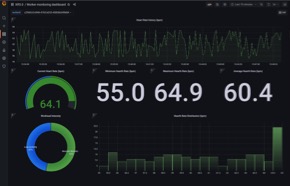
Figure 1. Worker Monitoring Dashboard
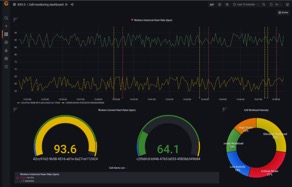
Figure 2. Cell Monitoring Dashboard
Figure 3. KUKA Robot Dashboard
Clawdite Functional Modules Supporting XR5.0 Pilots
Beyond monitoring, Clawdite plays a key role in directly supporting pilot-specific XR functionalities through dedicated functional modules.
- Pilot 1 – KUKA (Workers Movement Prediction): this module leverages real-time position and orientation tracking of workers in industrial environments. By forecasting future human movements, it enables robots to adapt their behavior intelligently while ensuring safety in human-robot collaboration.
- Pilot 4 – TAP (Worker Shadowing and Monitoring): this module combines expert knowledge transfer with process tracking. It stores and replays the “shadow” of expert Aircraft Maintenance Technicians while monitoring the execution of maintenance procedures. By tracking head and hand movements through XR visors, it provides real-time feedback and guidance.
- Pilot 5 – SPACE (Training Scenario Adaptability): this module integrates user-related data (e.g., age, expertise level) and biometric inputs (e.g., heart rate, HRV). These data streams feed into XR applications and AI models that compute engagement and stress metrics. The training environment can thus dynamically adjust task difficulty, personalizing the learning curve for each user.
- Pilot 6 – LNS (Troubleshooting Assistance): this module acts as a gateway, a central point of interaction for troubleshooting tasks. It integrates external services such as Innov AI Chat Engine, SIE Speech-to-Text, and Oculavis SHARE, delivering real-time support to workers through XR devices like RealWear.
Modularity as the Bridge to XR5.0 Pilots
HDTs were originally conceived to manage heterogeneous data collection and support worker fatigue monitoring. However, Clawdite is not confined to this scope. Its highly modular design has proven essential within XR5.0, enabling the seamless integration of diverse pilot-specific functionalities, ranging from movement prediction to workers monitoring, while maintaining a unified backbone (Figure 4) allowing Clawdite to flexibly adapt to diverse pilot requirements. As modules continue to mature, this flexibility will keep empowering training, support, and monitoring scenarios, paving the way for truly personalized Industry 5.0 environments.
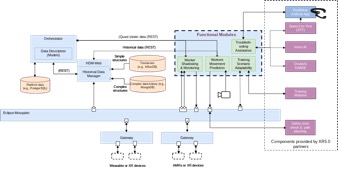
Figure 4. Clawdite Architecture
Authors: Samuele Dell’Oca, Davide Matteri, Vincenzo Cutrona, Elias Montini, Sara Masiero (SUPSI SPS lab)