
AI and XR Solutions Integration: Architectural Foundations for Industry 5.0
The convergence of Artificial Intelligence (AI) and Extended Reality (XR) technologies is revolutionizing industries, paving the way for the realization of Industry 5.0’s vision, which emphasizes human-centric, sustainable, and intelligent manufacturing. At the heart of this revolution lies the need for robust, scalable, and interoperable architectures that integrate these advanced technologies seamlessly. The XR5.0 Reference Architecture stands as a blueprint for achieving this integration, driving innovation and collaboration in human-machine ecosystems.
The Need for a Unified Architecture
Industry 5.0 envisions smarter, more adaptive systems where humans and machines work side by side to enhance efficiency, sustainability, and user experience. AI and XR technologies play a pivotal role in achieving this vision. AI brings intelligent decision-making, processing capabilities, and automation to the table, while XR enhances human interaction with immersive, real-time data visualization and contextualized assistance.
However, integrating these technologies into complex industrial environments requires a holistic approach. A unified reference architecture must address challenges such as data interoperability, modular design, scalability, and alignment with global standards. XR5.0’s architecture delivers on these needs by bridging the gap between cutting-edge tools and practical industry applications.
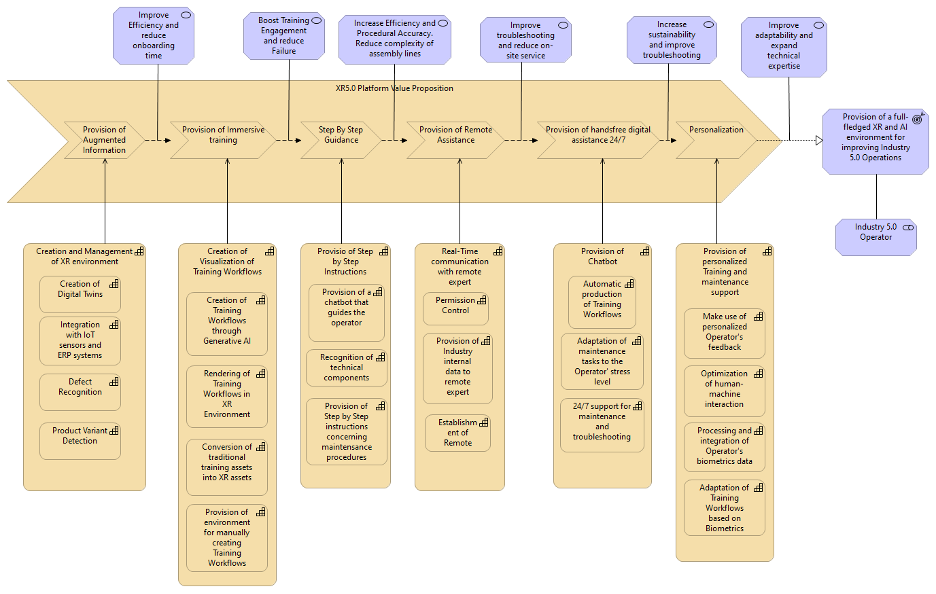
To set the stage for the XR5.0 Reference Architecture, a Value Stream was first explored, which outlines the flow of value from business needs to technological solutions. This foundational perspective provides critical context for understanding how XR5.0 enables seamless integration between AI and XR solutions.
Blueprint for Integration: The XR5.0 Architecture
The XR5.0 Reference Architecture lays the foundation for integrating AI and XR technologies into Industry 5.0 environments. Based on TOGAF [1] principles and modeled using ArchiMate [2] and C4 methodologies [3], this architecture is both strategic and actionable, addressing business, application, and technology layers.
Business Layer: Human-Centric Processes
The XR5.0 business layer focuses on creating value through human-centric processes. For example, it introduces services like Maintenance and Personalized Training Assistance, tailored to enhance operators’ capabilities. These services are mapped to business functions that leverage AI-driven insights and XR-enhanced visualizations. By aligning these processes with Industry 5.0’s goals, the architecture ensures improved decision-making, safety, and productivity.
Application Layer: Modular and Scalable Tools
At the application level, the architecture integrates tools for AI processing, XR visualization, and XR application orchestration. Components such as AI Models (including generative AI and explainable AI) and XR Visualization Tools ensure modularity, enabling flexibility and customization. These tools interoperate through defined interfaces and APIs, ensuring seamless communication across systems while being adaptable to future technological advancements.
Technology Layer: Interoperable Infrastructure
The technology layer emphasizes scalability, security, and performance. It incorporates cloud repositories, IoT integration, and high-performance computing environments to support the computational demands of AI and XR. By leveraging cutting-edge hardware and software standards, this layer ensures robust and efficient operations.
Alignment with Industry Standards
The XR5.0 Reference Architecture doesn’t exist in isolation; it aligns with established frameworks and standards to ensure compatibility, compliance, and interoperability. For example:
- RAMI 4.0 provides a structured approach to industrial systems, which XR5.0 mirrors in its layered design [4].
- OpenXR ensures cross-platform XR compatibility, seamlessly integrating immersive experiences into the workflow [5].
- XRSI emphasizes security and privacy, which are embedded in the XR5.0 architecture to protect sensitive industrial data.
This alignment not only boosts confidence in the architecture’s adaptability but also facilitates its adoption across diverse industrial settings [6].
Driving Innovation with Enterprise and Solution Architecture
To make the architecture accessible to diverse stakeholders, XR5.0 employs two complementary approaches:
- Enterprise Architecture: Offers a strategic view of the system, showing how business objectives align with technological capabilities. This is essential for senior stakeholders and decision-makers who need to understand the “big picture.”
- Solution Architecture: Provides operational-level detail, breaking down the system into components and workflows. This aids developers and implementers in translating the vision into practical solutions.
Together, these views ensure that the architecture is not only visionary but also actionable.
From Vision to Reality: Industry 5.0 in Action
The XR5.0 architecture is more than a theoretical framework—it’s a practical guide for building systems that embody Industry 5.0 principles. For instance, in troubleshooting scenarios, AI analyzes sensor data or images in order to identify failures, while XR visualizes this information in real-time, enabling operators to act swiftly. Similarly, in training environments, AI-driven adaptive workflows combined with XR’s immersive simulations empower workers with contextualized and hands-free guidance.
Such use cases demonstrate the tangible benefits of integrating AI and XR through a well-structured architecture, showcasing how Industry 5.0 can enhance both human and machine capabilities.
The Road Ahead
As industries continue to adopt AI and XR solutions, the role of architectures like XR5.0 will become increasingly critical. By ensuring interoperability, scalability, and alignment with global standards, XR5.0 provides a pathway for industries to embrace the full potential of Industry 5.0. This architecture is not just about technology, it’s also about creating systems that empower humans, improve efficiency, and drive sustainable growth.
With XR5.0, the future of Industry 5.0 is within reach, promising smarter, safer, and more connected industrial environments.
- The Open Group, TOGAF® Standard, 10th Edition: A Pocket Guide. The Open Group, 2022.
- The Open Group, ArchiMate 3.2 Specification. The Open Group, 2023. [Online]. Available: https://pubs.opengroup.org/architecture/archimate3-doc/
- S. Brown, “C4 Model for Software Architecture,” [Online]. Available: https://c4model.com/. [Accessed: 28-Nov-2024]
- Adolphs, P., Bedenbender, H., Dirzus, D., Ehlich, M., Epple, U., Hankel, M., Wollschlaeger, M. (2015) “Reference Architecture Model Industrie 4.0 (RAMI 4.0)”. VDI/VDE and ZVEI. Retrieved from https://www.zvei.org/en/subjects/industry-4-0/the-reference-architectural-model-rami- 40-and-the-industrie-40-component/ [last accessed 21/05/2021]
- Khronos Group, “OpenXR Specification,” The Khronos Group, [Online]. Available: https://www.khronos.org/openxr/. [Accessed: 16-Dec-2024].
- XRSI, “XRSI Privacy and Safety Framework,” [Online]. Available: https://xrsi.org/. [Accessed: Dec. 7, 2024].